Rock climbing on Bornholm – granite cliffs and routes by the Baltic Sea
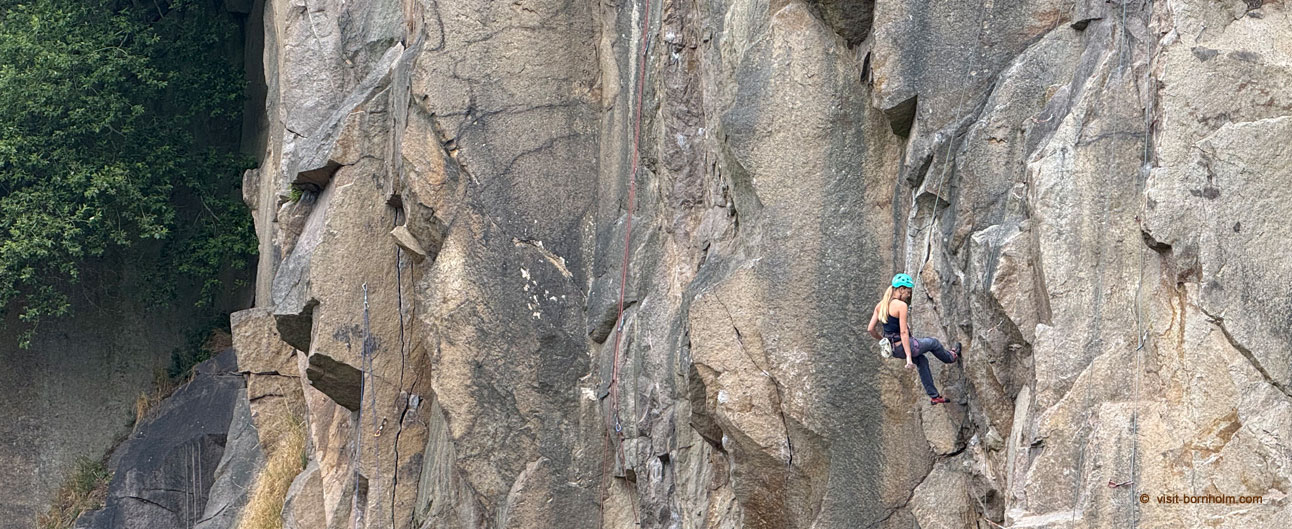
Bornholm is the only place in Denmark where you can climb on natural rock. The island offers around 1,000 climbing routes on gneiss and granite – from easy quarry routes, through bouldering on erratic blocks, to multi-pitch routes on sea cliffs up to 75 metres high. If you're looking for an unusual combination of climbing with beach time, grilled fish and a Baltic sunset – Bornholm is perfect.
Why Bornholm?
Most of Denmark is flat as a pancake. Bornholm is the exception – the island's bedrock consists of some of the oldest rocks in Scandinavia, over a billion years old. Granite sea cliffs, stone quarries carved over centuries and gneiss walls in forested valleys form a natural climbing park that no other region of Denmark can rival.
On top of that, there are practical advantages: the island's compact size (you can drive from any point to any climbing area in less than 30 minutes), a mild climate allowing climbing from April to October and often in winter too, plus tourist infrastructure – accommodation, campsites and harbours with restaurants close to the best crags.
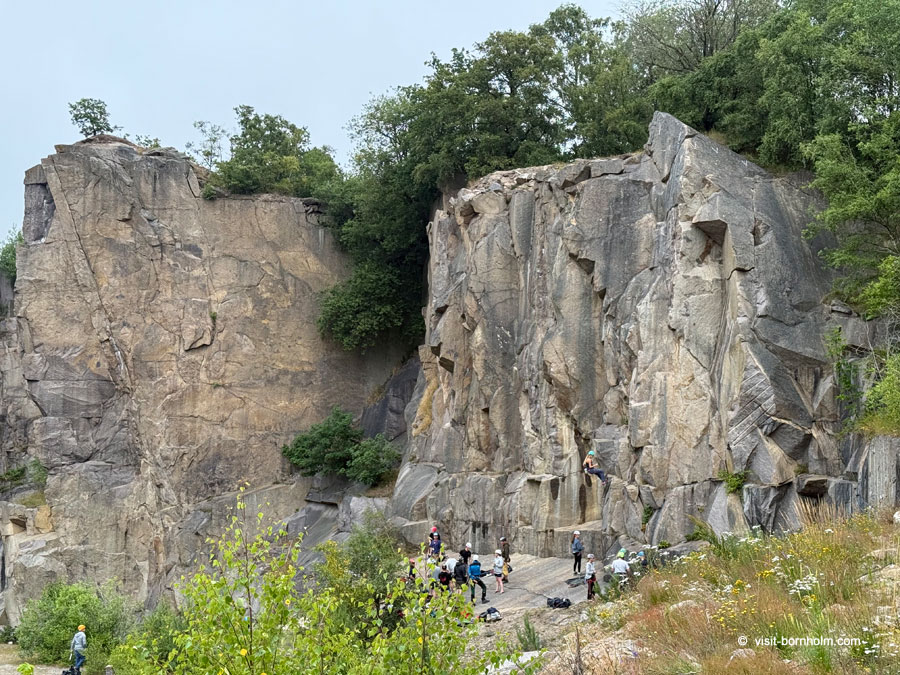
Types of climbing
Three main climbing disciplines can be practised on Bornholm – each in slightly different terrain and with different requirements.
Sport climbing
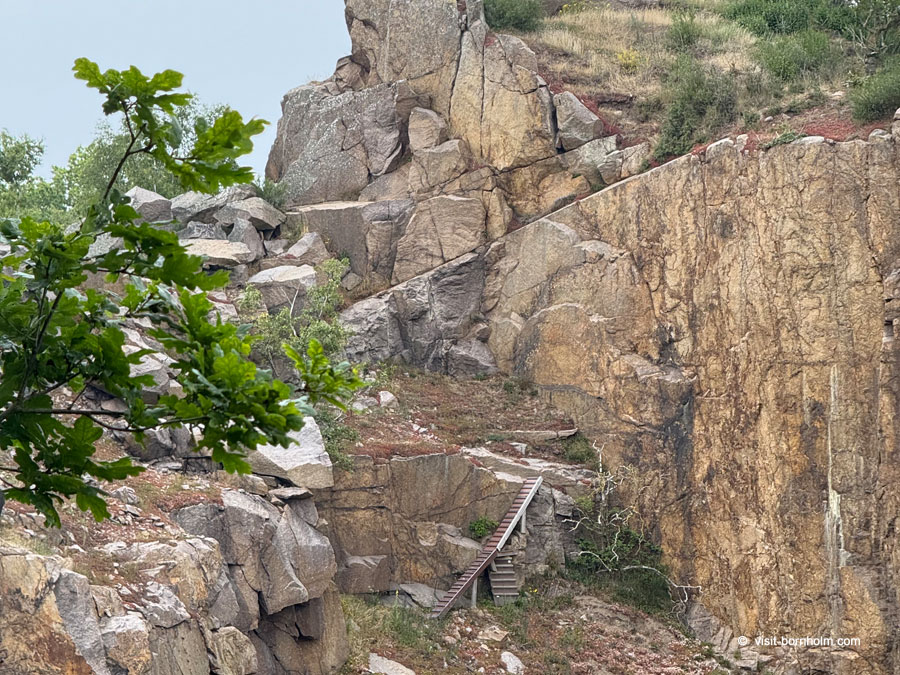
Routes with pre-placed bolts (anchors) in the quarries of Moseløkken and Ringebakkerne. Over 100 bolted routes. Moseløkken is the only place on the island where new routes may be bolted. Walls up to 60 m.
Traditional climbing
Classic trad climbing on sea cliffs and natural rock faces. No bolts – you use nuts, cams and natural protection points. Allowed on all sea cliffs (except seasonal restriction zones). The longest route is 75 m.
Bouldering
Ropeless climbing on low boulders and rock formations. Many boulder problems are still waiting to be discovered. A perfect option for short sessions and getting to know the rock.
Main climbing areas
Most climbing routes are concentrated along the northern and eastern coastline, but interesting spots can also be found inland. Below are the six best-known areas.
Moseløkken Stenbrud
An active granite quarry in the north of the island – the most important sport-climbing venue on Bornholm. Over 100 bolted routes of varying difficulty, walls up to 25 m. This is the only place on the island where bolting new routes is permitted. Climbing is allowed on weekends, public holidays, school holidays and other days when granite is not being quarried – exercise extreme caution on working days (machinery, blasting).
Moseløkken – facts
- Type: Sport climbing (bolted)
- Difficulty: From easy to advanced
- Bolting: Permitted – the only such place on the island
- GPS: N55.27363, E014.77699
Vangbruddet i Vang-Syd
The Vang quarry on the north-west coast with impressive walls and sea views. Next to the quarry lies the Vang-Syd area with sea cliffs – traditional climbing (no bolts) on natural rock. Note: the sea cliffs in this area are closed during the bird-nesting season (1 February – 15 August).
Vangbruddet – facts
- Type: Traditional climbing (sea cliffs), sport climbing (quarry)
- Sea cliffs: Closed 1 Feb – 15 Aug (bird-nesting season)
- GPS: N55.24377, E014.73427 (Vangbruddet), N55.24238, E014.72901 (Vang-Syd)
Hammerbruddet (Opalsøen)
An old quarry on the island's northern tip, featuring a distinctive turquoise lake (Opalsøen). Tall walls ideal for traditional climbing and rappelling. Bolting is prohibited here. One of the most photogenic climbing spots in Denmark.
Hammerbruddet – facts
- Type: Traditional climbing, rappelling
- Bolting: Prohibited
- GPS: N55.28426, E014.76181
Randkløve
A narrow, deep rock fissure on the east coast – one of Bornholm's most distinctive geological features. The walls of the crevice reach 20 m in height. An excellent spot for traditional climbing, combined with an experience of the island's raw, dramatic geology.
Randkløve – facts
- Type: Traditional climbing
- Terrain: Narrow rock fissure, walls approx. 20 m
- GPS: N55.17193, E015.03998
Lindesdal i Ørnebjergkysten
A forested valley and sea cliffs at the very north of the island – one of the wildest climbing areas. Lindesdal Hovedvæggen and Lillevæggen are two of the five locations officially permitted for climbing with gear on Naturstyrelsen land. Ørnebjergkysten (Eagle Mountain Coast) offers spectacular trad routes with open-sea views.
Lindesdal – facts
- Type: Traditional climbing, climbing with gear (Naturstyrelsen permit)
- Note: Official Naturstyrelsen permit for climbing with gear
- GPS: N55.287741, E14.752955 (Hovedvæggen)
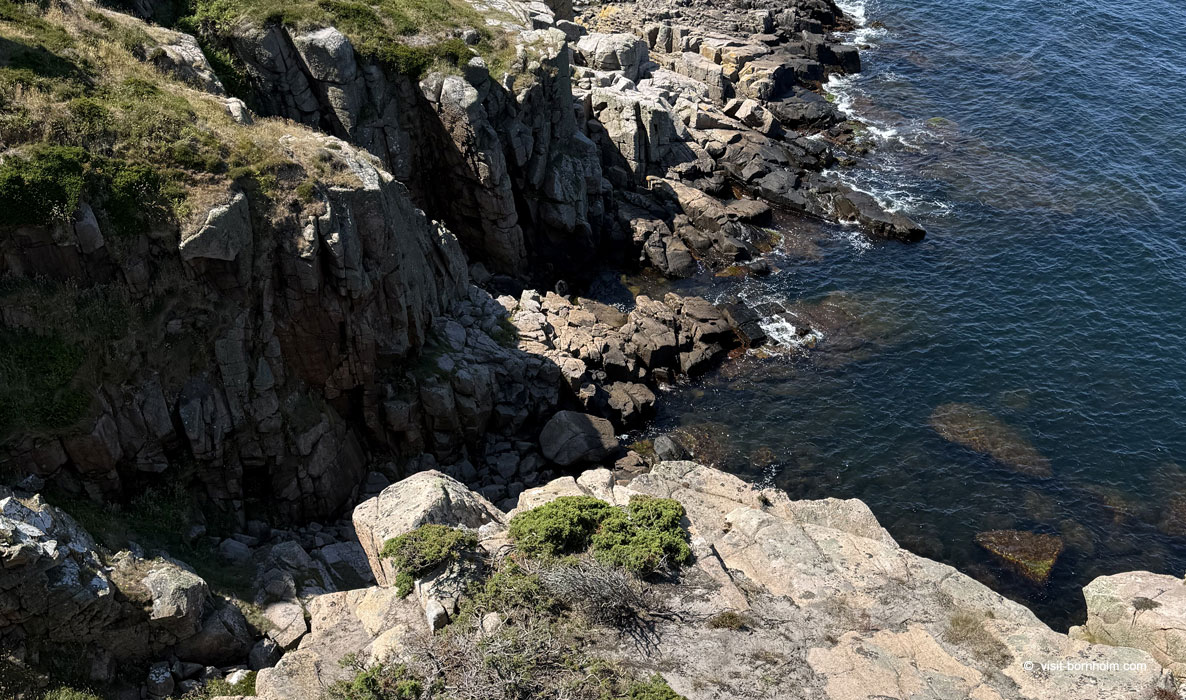 Granite cliffs of northern Bornholm – the only natural climbing walls in Denmark
Rules and restrictions – read before you climb
Climbing on Bornholm offers exceptional freedom, but specific regulations apply. Following them protects the island's unique environment and ensures safety.
Seasonal closures
From 1 February to 15 August climbing is banned on several sea-cliff areas due to bird nesting: Mulekysten (Vang – Hammershus), Kælderbakken (west of Hammeren lighthouse), Kongestolen (north of Hammerhavn) and part of Vangbruddet (peregrine falcon protection – closed year-round).
Absolute bans
Climbing is prohibited at: Helligdomsklipperne, the Hammershus ruins and the part of Ekkodalen managed by Naturstyrelsen. In addition, Klippeløkken Stenbrud has a complete climbing ban.
Climbing with gear
Climbing with ropes, nuts and other protection gear on Naturstyrelsen land requires prior notification and approval. Friklatring (without gear) in groups of up to 5 people – no notification required. Groups of more than 5 must obtain a permit.
Bolting
Bolting new routes is permitted only at Moseløkken Stenbrud and in most of Ringebakkebruddet. On all sea cliffs, natural rock, at Hammerbruddet and Bjergbakkebruddet – bolting is prohibited. Only traditional climbing is allowed.
All climbing areas – map and GPS
Bornholm has 18 official climbing areas. Below is the full list with numbers corresponding to the map in the "Bornholm on the Rocks" guidebook and GPS coordinates.
| # | Area | GPS |
|---|---|---|
| 01 | Jons Kapel | N55.23201, E014.71976 |
| 02 | Almeløkkebruddet i Ringedalen | N55.23766, E014.73212 |
| 03 | Vang-Syd | N55.24238, E014.72901 |
| 04 | Vangbruddet | N55.24377, E014.73427 |
| 05 | Hammershusområdet | N55.26213, E014.74773 |
| 06 | Hammeren i Ørnebjergkysten | N55.28756, E014.75280 |
| 07 | Hammerbruddet | N55.28426, E014.76181 |
| 08 | Moseløkken Stenbrud | N55.27363, E014.77699 |
| 09 | Lundegårdsbruddet | N55.25503, E014.80968 |
| 10 | Stammershalle | N55.24085, E014.86453 |
| 11 | Røstad | N55.22084, E014.91204 |
| 12 | Gudhjemområdet | N55.20955, E014.97750 |
| 13 | Randkløve | N55.17193, E015.03998 |
| 14 | Svaneke | N55.13958, E015.13921 |
| 15 | Årsdale | N55.11213, E015.14384 |
| 16 | Svenskehavn | N55.08776, E015.15387 |
| 17 | Paradisbakkerne | N55.09936, E015.08865 |
| 18 | Bjergebakkebruddet | N55.11953, E014.83012 |
Climbing areas map
Season and weather
You can climb on Bornholm year-round, but the best season is April–October. A mild spring, warm summer and golden autumn provide comfortable conditions. The rock dries quickly after rain thanks to the island's windy position.
In winter the temperature rarely drops below –5°C, so climbing is possible on dry days. In exceptional conditions, frozen waterfalls even appear for ice climbing – but that is an option for experienced and properly equipped climbers only.
Guidebook and festival "Bornholm on the Rocks"
The main source of route information is the book "Bornholm on the Rocks" (over 400 pages) by Karsten Kurz – a German climber who has been exploring Bornholm's crags for years. The guidebook contains route descriptions, photo topos, access maps and information about access to individual areas. Updates on new routes and areas are published on the publisher's website and in the Facebook group Bornholm Climbing Guide.
Every year the island also hosts the "Bornholm on the Rocks" festival – Denmark's largest climbing gathering, spanning 5 days, with workshops, lectures and communal sessions on the rocks. The first festival was held in 2011 and attracts over 100 participants.
Climbing schools and guides
Local instructors on Bornholm offer climbing and rappelling courses for beginners as well as guided sessions for groups. The most popular outings are organised on the cliffs of Hammerknuden. If you've never climbed on natural rock – Bornholm is one of the best places to start: the granite offers plenty of good holds and the instructors know the terrain inside out.
Accommodation near the rocks
Most climbing areas are in the north of the island – near Sandvig, Allinge and Gudhjem. In these towns you'll find campsites, guest rooms, apartments and hotels. If you're planning a multi-day climbing trip and want to keep costs down – shelters and free tent sites are a popular option among climbers visiting the island.