Pyritsøen – the largest former clay pit, pyrite and dinosaur tracks near Hasle
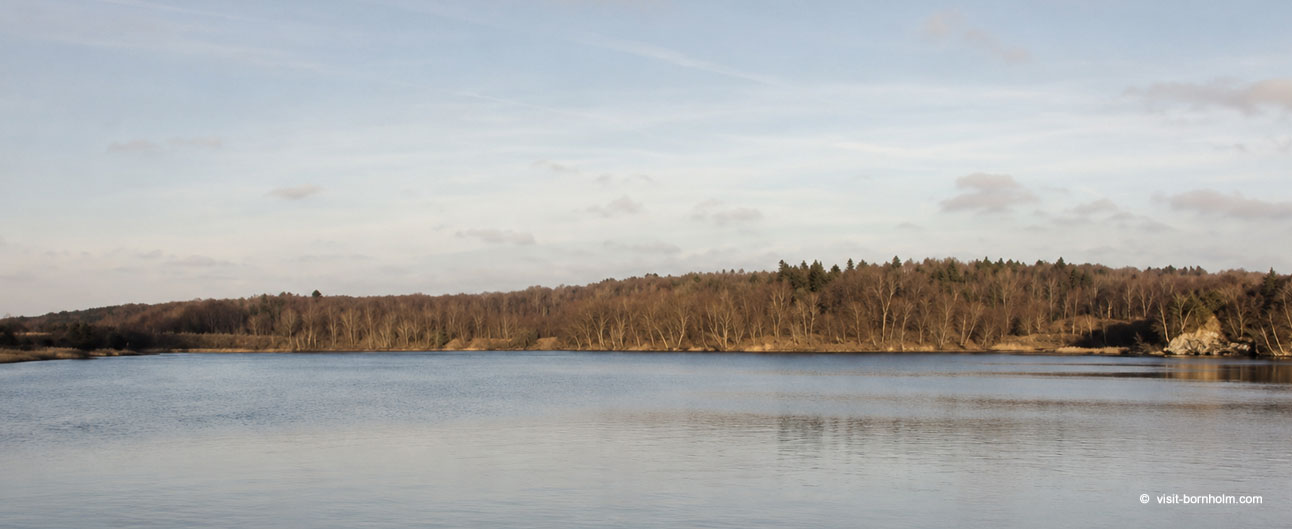
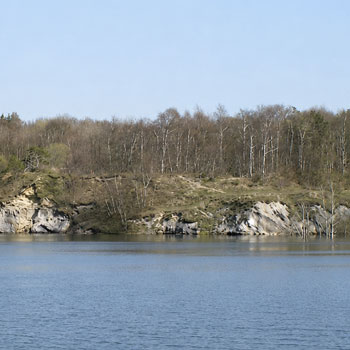
Pyritsøen (Danish for “pyrite lake”) is the largest woodland pond among the former clay pits west of Hasle — a broad, calm lake filling Bagågraven, where clay was extracted for much of the 20th century for Hasle Klinker- og Chamottestensfabrik. The name recalls pyrite (“fool’s gold”) in the geological layers; nearby rises Lertippen, a spoil bank separating fresh water from the Baltic. The site blends industrial history, Jurassic geology and some of Denmark’s best-known palaeontological discoveries.
Bagågraven, Lertippen and the pyrite name
Around 1900, when deepening at Smaragdsøen stopped because of strong groundwater, work moved to Bagågraven — today’s Pyritsøen. Clay was hauled from here to the brick factory for decades; waste was piled on the narrow Lertippen strip between lake and sea. Thick beds of clay, sandstone and lignite were exposed in the pit walls — geologists studied Middle Jurassic deposits here, roughly 170 million years old. When extraction ended in the late 1980s, the pit flooded; around 1990 the pond was named Pyritsøen after abundant pyrite nodules in the coal layers. Today the surface sits slightly above sea level beyond Lertippen — while coastal erosion slowly eats at the bank, which in time could link Pyritsøen to the Baltic.
Dinosaur tracks and Bornholm’s special place in Denmark
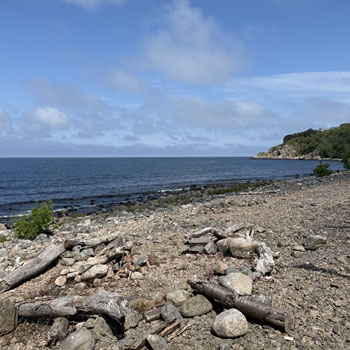
Bornholm is the only part of Denmark that stood above water in the Mesozoic — which is why the discovery of ~170-million-year-old dinosaur footprints in sandstone near Pyritsøen in 2004 caused such excitement. Later finds (including in 2010) confirmed several types, from sauropods to armoured herbivores and predator tracks. Replicas and the excavation story are shown at NaturBornholm; an information board with illustrations stands at the entrance — worth reading before a walk along the beach and Lertippen.
Pyritsøen is also valued by birdwatchers — the quiet surface and surrounding forest attract water and woodland species year-round. Marked paths link the lake with neighbouring Smaragdsøen, Safirsøen and the coast between Hasle and Levka.
Angling and the shoreline
Pyritsøen holds pike and perch among other fish — according to tourist information no fishing licence is required here (unlike Smaragdsøen). Banks can be awkward, yet the lake is popular with local anglers. On the coast between Pyritsøen and Levka you may target sea trout and other marine species — standard sea-fishing rules apply there.
- Largest former clay pit in the Hasle area (Bagågraven; extraction until the late 1980s)
- Lake angling: pike, perch — no fisketegn required (per tourist information)
- Dinosaur footprints (~170 million years) by the shore; display at NaturBornholm
- Lertippen separates lake from sea — slow erosion of the bank from the Baltic
- Popular birdwatching; paths to Smaragdsøen and the coast
Nearby: Smaragdsøen and other Hasle lakes
Pyritsøen lies right beside Smaragdsøen — a forest trail runs between the two, letting you see the factory’s first and second clay pits in one outing. Further inland lie Safirsøen and Rubinsøen; to the south, surreal Kultippen with its “lunar” post-mining landscape.
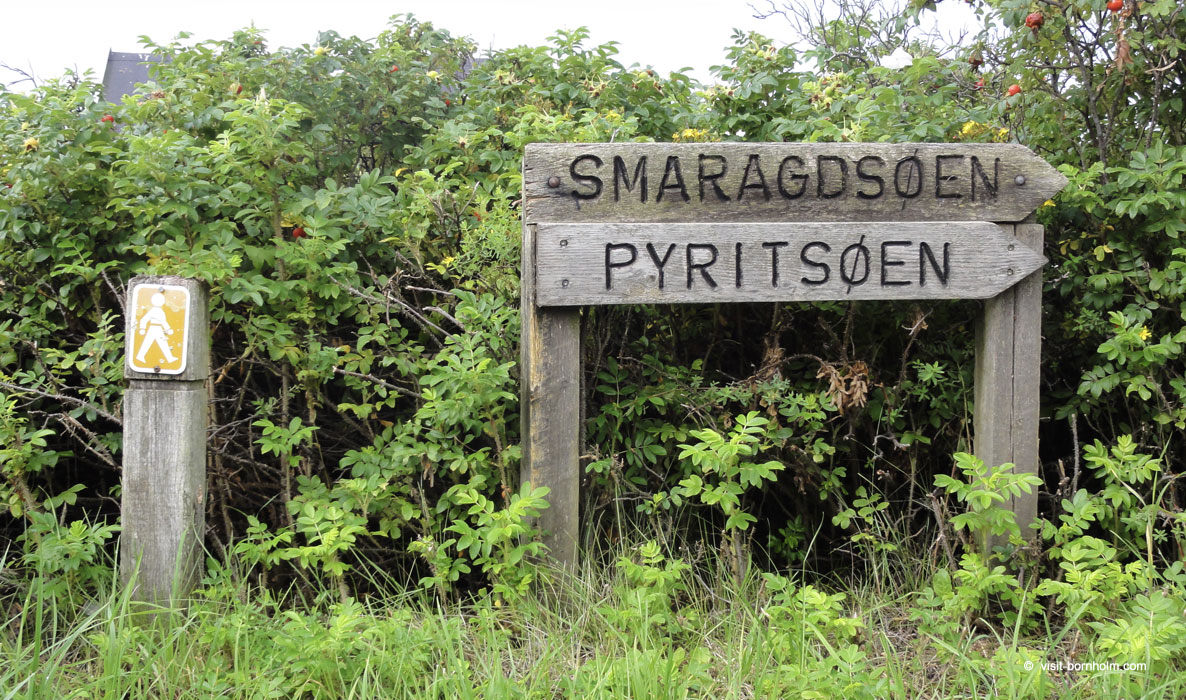 From Pyritsøen, a marked path leads through the trees towards Smaragdsøen
Good to know about Pyritsøen
- Bagågraven — main Hasle Klinker clay pit (c. 1900 – late 1980s)
- Name Pyritsøen from pyrite (“fool’s gold”) in coal beds
- Dinosaur tracks by the shore (from 2004); Bornholm the only “dry” part of Denmark in dinosaur times
- Lake angling without fisketegn; pike and perch
- Lertippen — narrow bank between lake and sea, vulnerable to erosion
Lokalizacja
| Pyritsøen | |
| Havvej, Sorthat, 3790 Hasle | |
| The lake lies in Hasle Klinker Skoven (Sandflugtsskoven), west of Hasle, just inland from the coast beyond Lertippen. Reach it on foot or by bike from Hasle; an information board stands at the entrance. | |
| No large car park at the lake — leave your car in Hasle and walk in on forest paths. |