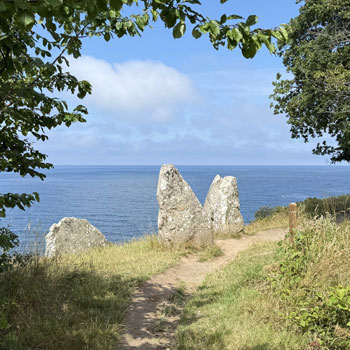
Salene Gravplads – Iron Age burial site on Bornholm's coast
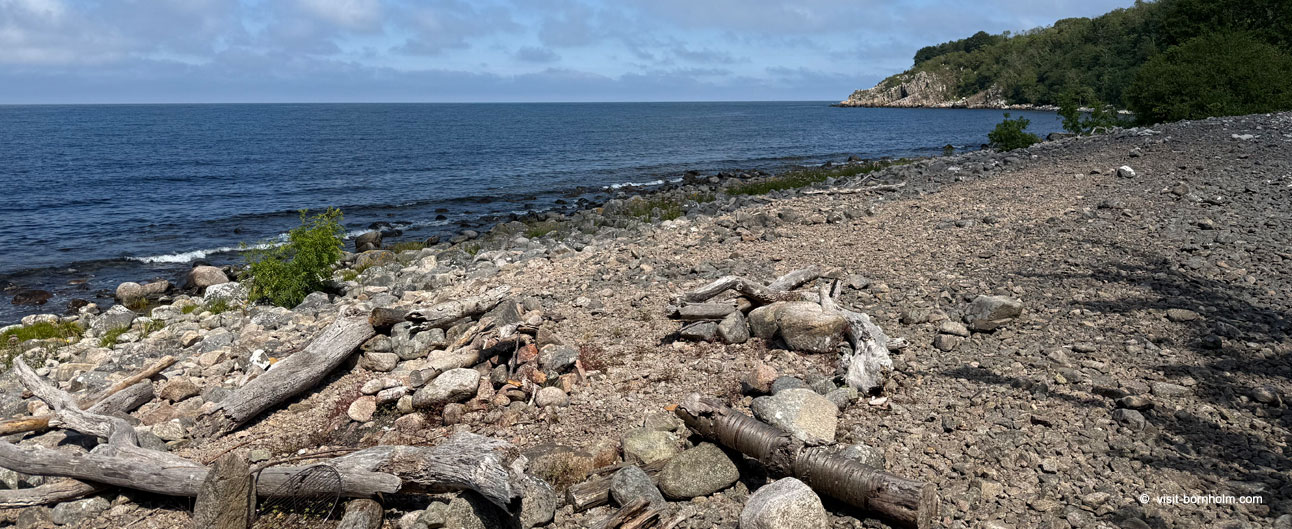
On the pebble beach at Salene stand around thirty low cairns of beach stones — grave markers from the Iron Age. They are the remains of an ancient burial ground (roughly 500 BC–AD 850), one of the most distinctive archaeological sites on Bornholm's north-eastern coast. The same landscape combines shingle and moraine, the mouth of the Bobbe River (Bobbeå), old coastal fortifications and wild cliffs — a place worth a walk not only for history lovers.
The path to the burial ground
Leave your car at the Bobbe Bro car park (Helligdomsvej 7B) or at the end of Bobbevej by Salene Bay (Salene Bugt) — parking spaces are limited. By the house at Bobbevej 8 a path crosses the field towards the forest and shoreline. After about fifteen minutes you reach the shingle beach where stone cairns appear at regular intervals. As early as the late 19th century some graves were excavated here: unburnt skeletons were found, few grave goods, and a single pottery vessel dated to the Roman Iron Age (around AD 200). Nearby you can also see rectangular stone foundations — probably the remains of an older building, though not precisely dated.
The cairns and protection of the site
On the eastern part of Salene beach, in an old moraine ridge, a larger group of stone cairns has survived — nature studies mention as many as about thirty-five mounds. It is one of the few grave fields of this type so clearly visible in Denmark; the site was protected in 1894, and a landscape conservation order from 1939 was intended to safeguard the area from building development. Today much of the land belongs to the state and adjoins forest managed as pristine woodland left in its natural state. Walk carefully: the cairns are protected monuments, and the pebbles form a sensitive, living coastal landscape.
Good to know about Salene Gravplads
- About 30–35 visible stone cairns on the shingle beach in the eastern part of Salene
- Dating: Iron Age; one excavated grave contained pottery from around AD 200
- Protected since 1894; additionally safeguarded against building development in 1939
- Access on foot via the path at Bobbevej 8 — open-air site, free to visit
- Nearby: the mouth of the Bobbe River (Bobbeå), Bobbe Bridge (Bobbebro) and Bornholm's north-eastern cliffs
Lokalizacja
| Salene Gravplads | |
| Bobbevej 5, 3760 Gudhjem | |
| A path from Bobbevej 8 leads along the coast to the cairns. The site is on Salene beach. | |
| Parking at Bobbe Bro (Helligdomsvej 7B) or at Salene Bugt at the end of Bobbevej — limited spaces. |