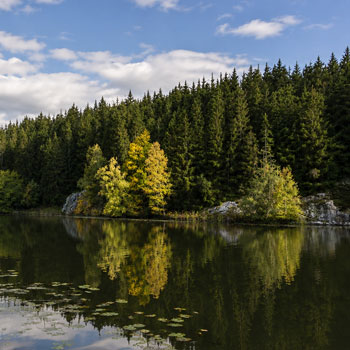
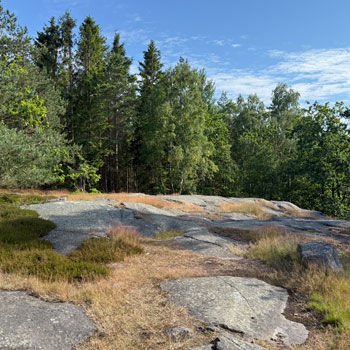
Almindingen – the forest in the heart of Bornholm
Almindingen is Denmark's third largest forest, stretching across 3,800 hectares in the central part of Bornholm. This vast woodland complex encompasses valleys, lakes, bogs, heathlands and ancient oak groves, making it one of the most ecologically valuable areas on the island. Here you will find the highest point on Bornholm, the ruins of two medieval castles and Denmark's only herd of European bison.
History of the forest
The name Almindingen comes from the Danish word for "common pasture" – for centuries the forest served Bornholm's inhabitants as grazing land for cattle. By the end of the 18th century, trees had almost completely disappeared from the area. In 1800, forest warden Hans Rømer began a large-scale afforestation programme, fencing off the area in 1809 to protect the new plantings. The results of his work are still visible today – massive stone walls running along the forest boundaries, built to prevent deer from entering areas with young trees. Thanks to these efforts, Bornholm became the most densely forested region in Denmark by the early 20th century.
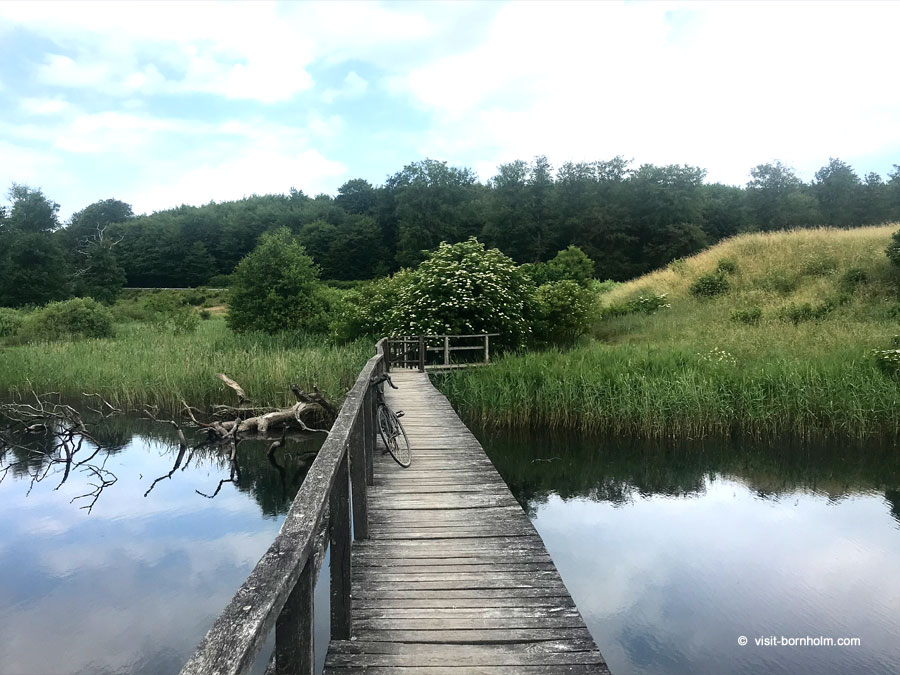
Ekkodalen – Echo Valley
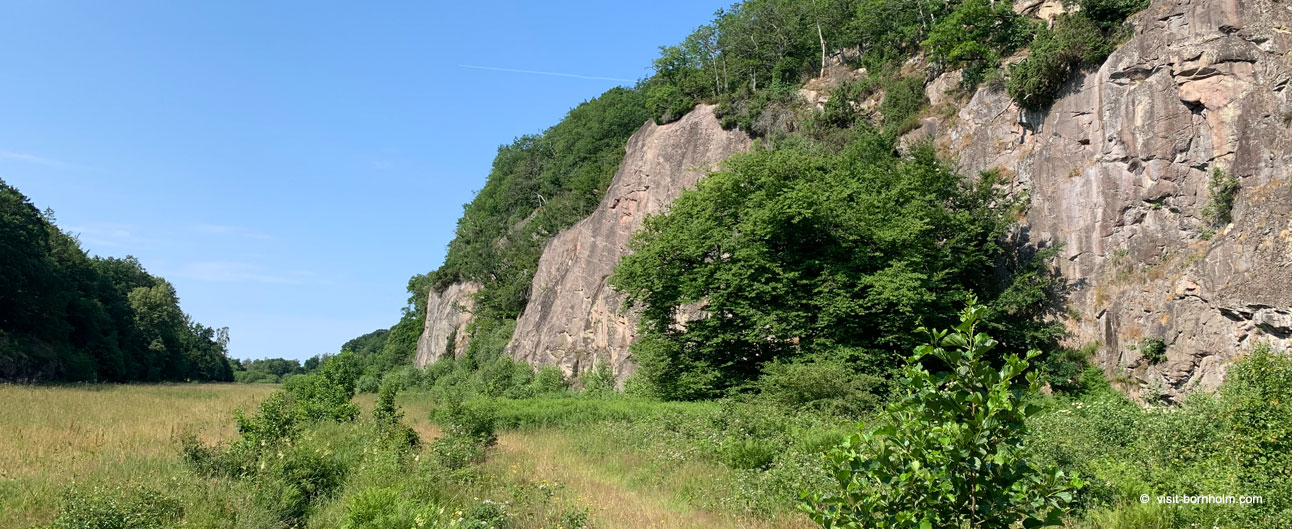
Ekkodalen is the largest rift valley on Bornholm and one of the most recognisable sites in Almindingen. The narrow, several-hundred-metre-long valley is surrounded by steep rock walls that reach up to 20 metres in height in places. The valley is famous for its remarkable acoustics – simply stand facing the cliffs and call out to hear a clear echo bouncing back multiple times from the rock faces.
At the entrance to the valley you will find the Hans Christian Ørsted spring, commemorating the visit of the renowned Danish physicist. A walk through Ekkodalen leads through lush vegetation, along streams and past distinctive rock formations. The valley is a protected conservation area and one of the island's most valuable geological sites.
Rytterknægten – the highest point on Bornholm
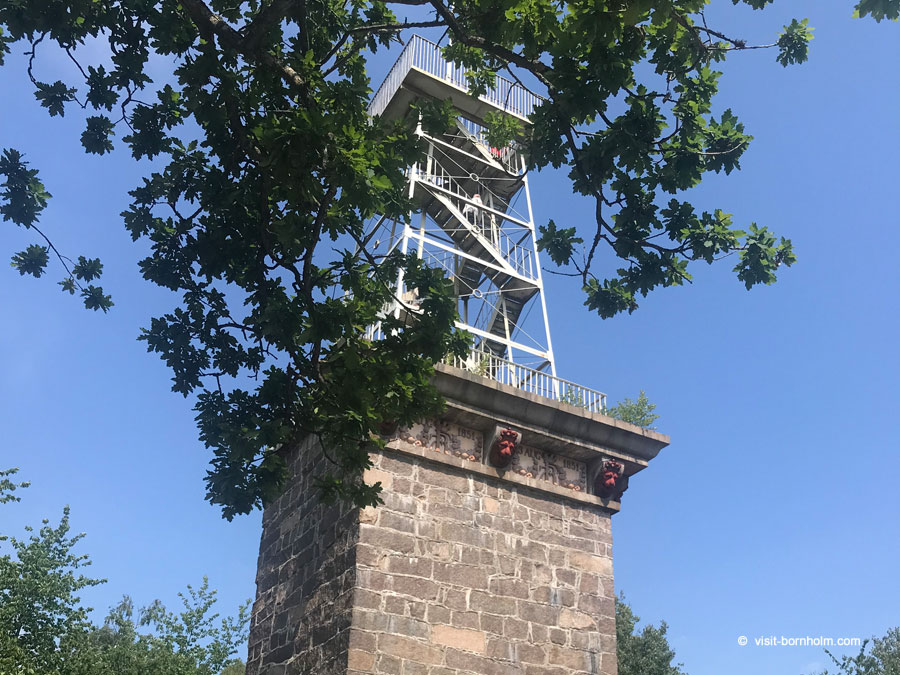
Rytterknægten rises to 162 metres above sea level and is the highest point on Bornholm. At the summit stands an obelisk erected in 1856 to commemorate the visit of King Frederick VII and Countess Danner to the island in 1851. Right next to it is an observation tower, originally built in 1899 and later raised with a steel structure. From the top of the tower you have a panoramic view over the treetops of Almindingen, and on clear days the distant coastline of the island is visible.
The tower is free to visit and open all year round. Well-marked hiking and cycling trails lead here, making it easy to reach the summit – even for families with children.
European bison
In 2012, the Danish Nature Agency brought seven European bison from the Polish wilderness to a specially prepared, fenced area of approximately 80 hectares in the central part of Almindingen. It was a historic moment – for the first time in 2,500 years, Europe's heaviest land mammals were present in Denmark once again.
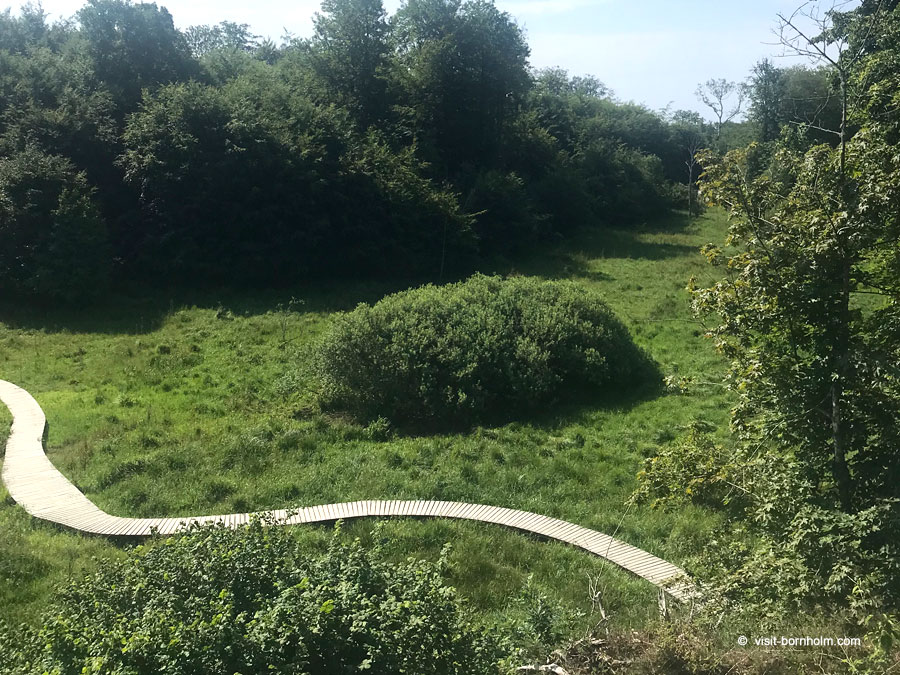
The herd can be observed from designated viewpoints. NaturBornholm periodically organises guided tours to the bison enclosure. The chance of seeing the animals depends on the time of day and season, but the walk around the enclosure itself is a unique experience in the heart of Bornholm's forest.
Lilleborg and Gamleborg – medieval castles
Deep within Almindingen lie the ruins of two medieval fortresses that played an important role in the history of Bornholm.
Gamleborg is the older of the two – built in the 10th–11th century as the largest fortified Viking stronghold on the island. Surrounded by natural hills and stone walls, it controlled the routes running through central Bornholm. Over time it lost its strategic importance to a newer fortress.
Lilleborg was built in the 12th century as the seat of the bishops of Lund. Situated above the scenic Lake Borresø, it had a more advanced defensive design and served as the centre of ecclesiastical power on the island. Today, fragments of walls and foundations remain, and the exceptional location on a rocky hilltop overlooking the forest gives the site a particularly atmospheric quality. A walk between the two fortresses follows forest paths and takes about an hour.
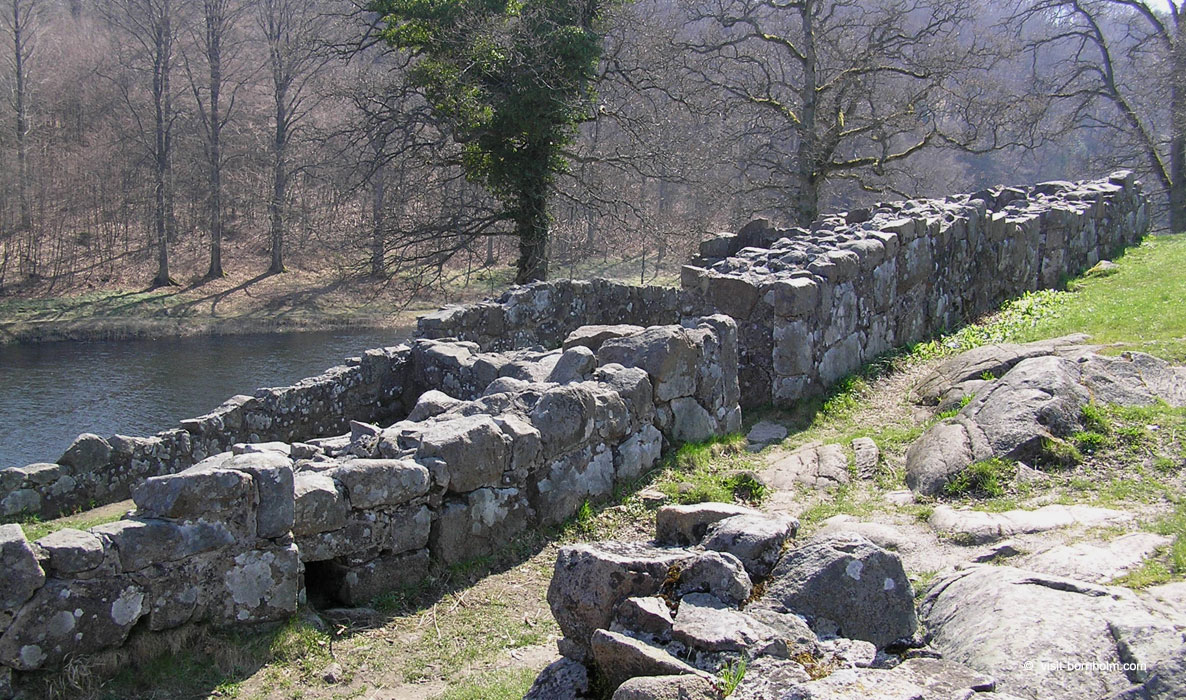 Ruins of Lilleborg by Lake Borresø
Nature and conservation
Almindingen is not just a forest but a vast ecosystem comprising valleys, peat bogs, heathlands and lakes. The area is protected under the EU Birds Directive and Habitats Directive, and BirdLife International has listed Almindingen as an Important Bird Area. Over 210 bird species have been recorded in and around the forest, including the red kite, osprey, crane, black woodpecker, marsh harrier and Tengmalm's owl.
The Ølene reserve in the eastern part of the complex is completely closed to visitors to protect its valuable habitats. Ekkodalen and the Vallensgård and Kærgård peat bogs are also protected. Bird observation towers are located throughout the forest – you will find them at Udkæret, Bastemose, Svinemose, Ølene and Rømersvej.
Hiking trails
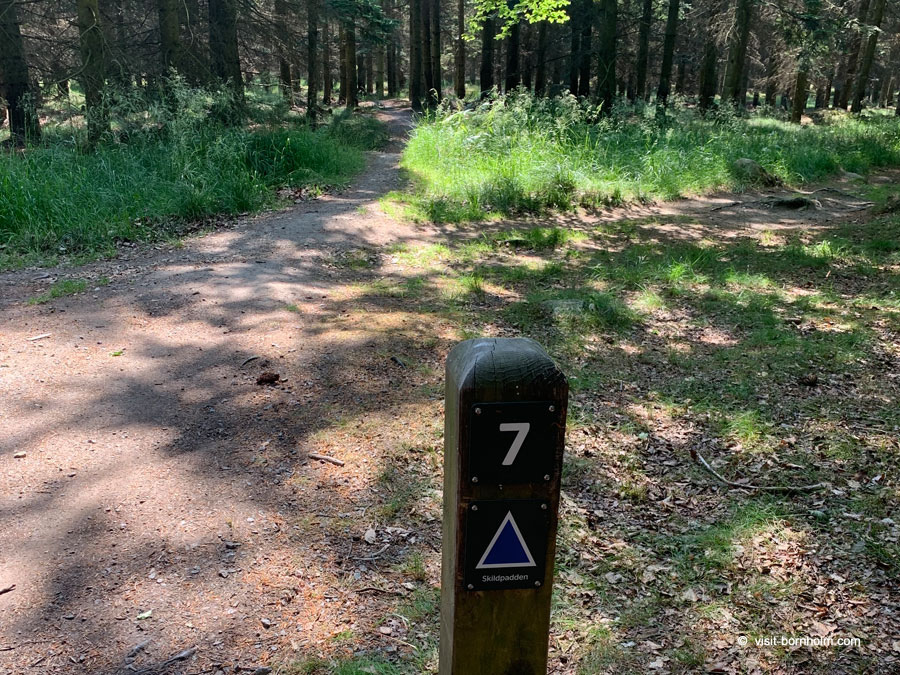
Almindingen has four main hiking trails of varying length and character, all well marked:
| Trail | Length | Route description |
|---|---|---|
| Trail 1 | approx. 4 km | A gentle introductory route into the forest atmosphere |
| Trail 2 | approx. 4 km | Through Ekkodalen to Rytterknægten – Ørsted's spring and the observation tower |
| Trail 3 | approx. 4 km | Diverse trees, meadows and lakes, Arboretum from 1932 |
| Trail 4 | approx. 5 km | Lakes Græssøen, Dyresøen and Borgesøen, ruins of Gamleborg and Lilleborg |
In addition to hiking trails, the forest has cycling and horse riding routes. The forest is also popular among runners – Trailcenter Almindingen offers routes of varying difficulty through the forested hills.
Overnight stays in the forest
In Almindingen, between the roads Bolsterbjergvej and Åsedamsvej, wild camping is permitted. Local rules apply – details are available on the Danish Nature Agency (Naturstyrelsen) website. The forest also has primitive camping spots and shelters for those who prefer to spend the night in nature.
Budget accommodation on Bornholm – more info
Good to know about Almindingen
- Almindingen covers 3,800 hectares, making it Denmark's third largest forest
- The forest was planted in the early 19th century by forest warden Hans Rømer – previously the area was almost treeless
- In 2012, European bison were brought from Poland – the first in Denmark in 2,500 years
- Over 210 bird species have been recorded in the forest
- Entry to the forest, observation tower and viewpoints is free all year round
Location
| Almindingen | |
| Central part of Bornholm, between Rønne, Aakirkeby and Gudhjem | |
| Free parking at the main forest entrances – including Rytterknægten, Ekkodalen and the trails to Lilleborg and Gamleborg | |
| naturstyrelsen.dk |