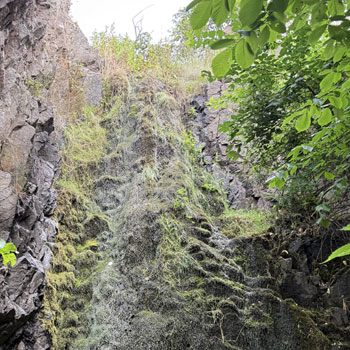
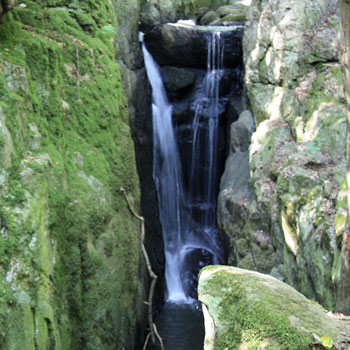
Døndalen – Denmark's Most Visited Waterfall
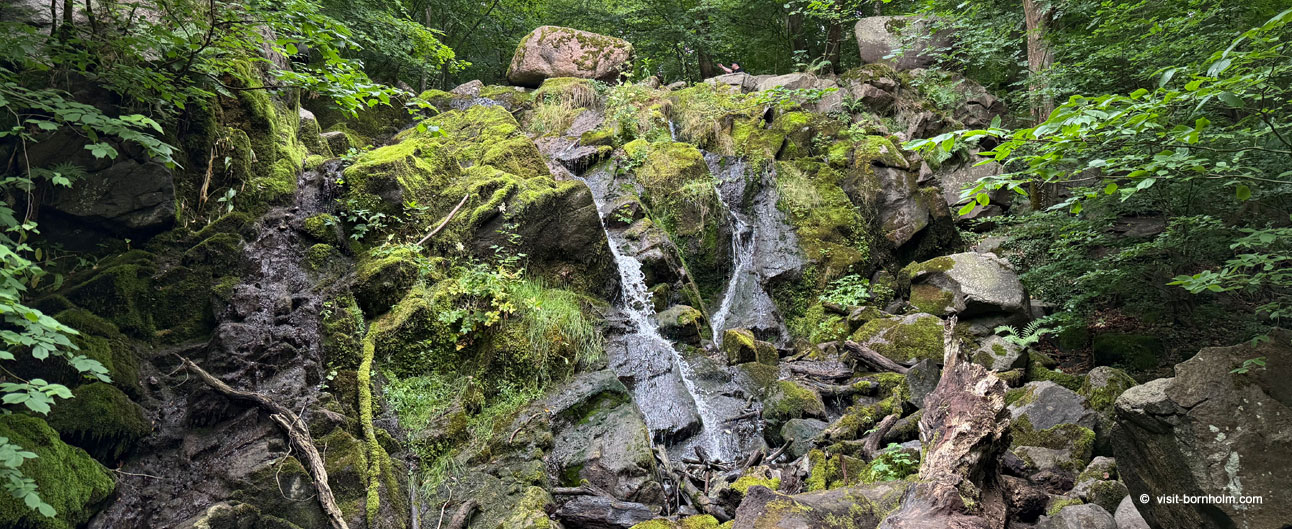
Døndalen is a picturesque valley on the east coast of Bornholm, home to Denmark's third highest waterfall. The Døndaleå stream drops from a height of about 20 metres, making it the most visited waterfall in the country. The valley is beautiful in every season, but it is at its most spectacular just before the leaves unfold, when the forest floor is covered with wood anemones and pungent wild garlic, and nightingale song echoes between the rocky walls.
The waterfall and viewpoint
In the heart of the valley, the Døndaleå stream cascades down from a height of about 20 metres, forming Denmark's third highest waterfall. The north-western wall of the valley rises to 20 metres, creating an imposing rock cliff whose summit serves as the Amtmandsstenen viewpoint. From here you can enjoy a magnificent view of the valley's treetops, the Baltic Sea, and the island of Christiansø on the horizon.
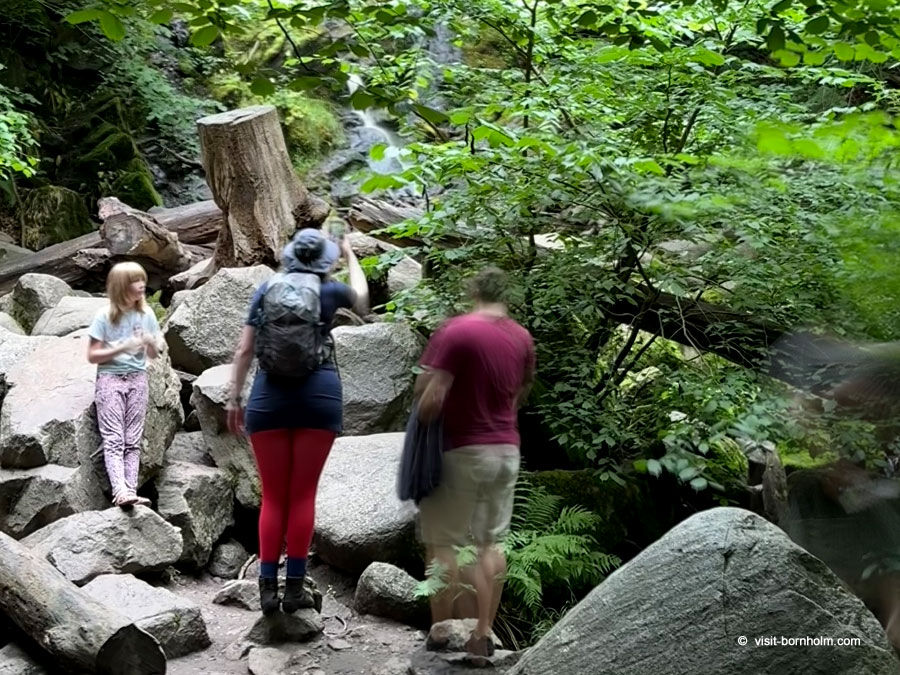
Easy route to the waterfall
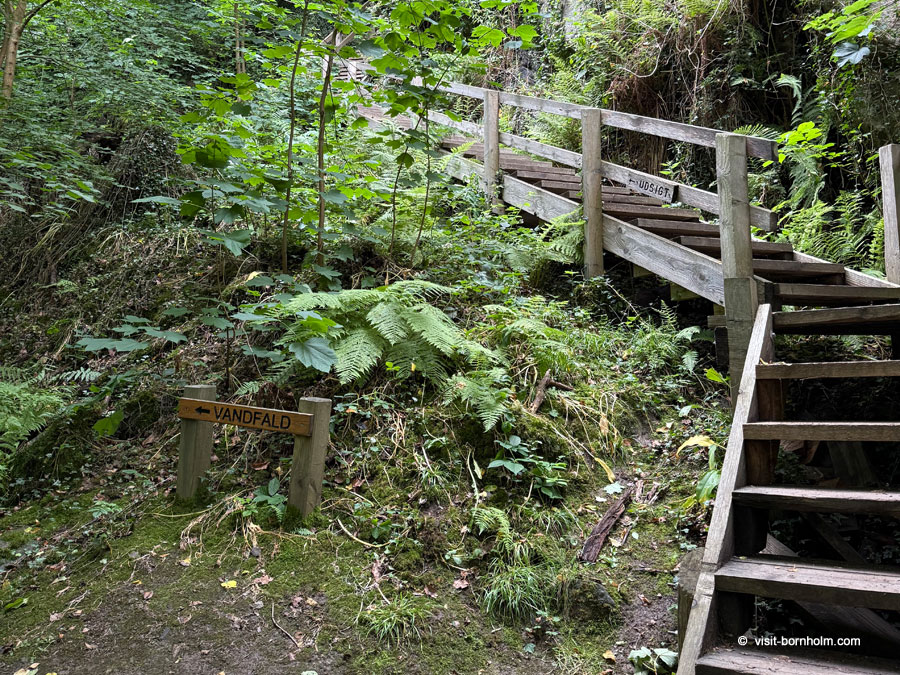
The easiest route through Døndalen to the waterfall is just under 2 km return and takes about an hour. It follows wide, well-maintained forest paths, making it accessible for people with limited mobility and families with smaller pushchairs. The stairs leading to the Amtmandsstenen viewpoint, however, are more demanding and require a reasonable level of fitness.
Longer route for experienced hikers
For more experienced hikers, the trail continues beyond the waterfall to Røvejen road. This longer loop covers approximately 4 km in total and can be completed in about 1.5 hours. From Røvejen there is a view of the entire valley from the opposite side. Along this route the difference between the lower, almost park-like part of Døndalen (from the car park to the waterfall) and the rest of the valley, designated as unmanaged forest resembling primeval woodland, becomes particularly apparent.
Best time to visit Døndalen
Døndalen is beautiful all year round, but each season offers something special. Spring is the most magical time – the forest floor is blanketed in wood anemones and pungent wild garlic, while the valley resounds with nightingale song. In winter and early spring it is worth bringing wellington boots – the ground can be muddy, but the effort is well rewarded. After a long, snowy winter, abundant meltwater fills the Døndaleå stream and gives the waterfall a truly impressive character.
Geology of the valley
Døndalen stands out among Bornholm's rift valleys by being considerably wider. The reason lies in its different geological origin. Unlike the other rift valleys, Døndalen was formed when a section of bedrock subsided below the surrounding terrain – in what is known as a tectonic graben (gravsænkning). The valley covers an area of 37 hectares, of which about one third is unmanaged forest, ensuring a rich animal and plant life.
Nature conservation
Døndalen has been protected since 1975 and is now owned by the Danish Nature Foundation (Danmarks Naturfond). Thanks to this, the valley retains its natural, wild character and provides a refuge for numerous species of birds, plants, and animals.
Budget accommodation on Bornholm – more information
Good to know about Døndalen
- The waterfall in Døndalen is Denmark's third highest and also the most visited in the country
- The Døndaleå stream drops from a height of about 20 metres, and the north-western rock wall also reaches 20 m
- The easiest trail to the waterfall is under 2 km and is accessible with pushchairs
- The valley is at its most beautiful in spring, when wood anemones and wild garlic bloom and nightingale song fills the air
- Døndalen has been protected since 1975 and belongs to the Danish Nature Foundation
- Entry to the valley is free of charge and open all year round
Location
| Døndalen | |
| Søndre Strandvej 144 A, 3760 Gudhjem | |
| Near Bornholms Kunstmuseum (Bornholm Art Museum) | |
| Free parking at the entrance to the valley | |
| Navigate: |